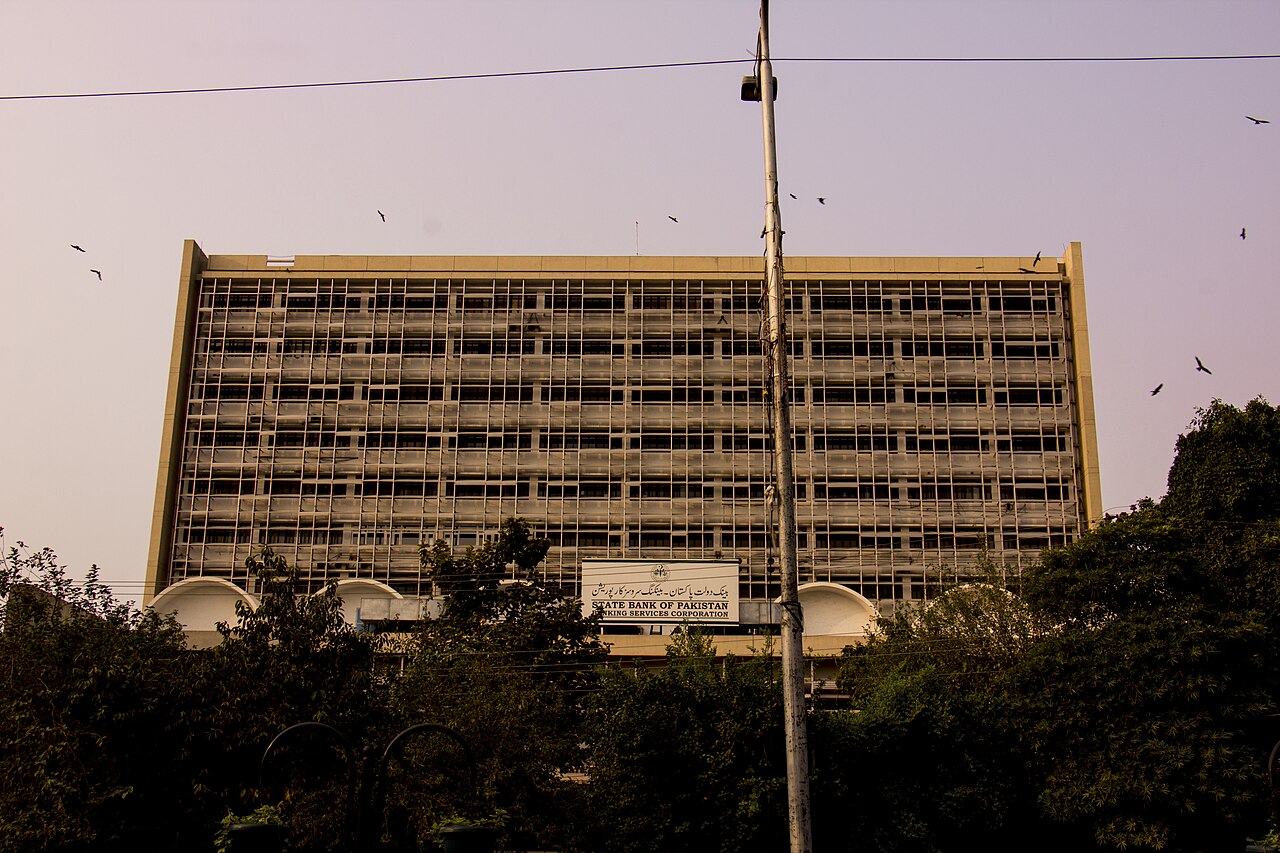
Photo: MariyamAftab / Wikimedia Commons ↗, CC BY-SA 4.0 ↗. State Bank of Pakistan building in Lahore, photographed in 2017.
October 24, 2026. The State Bank of Pakistan has revised the limits that apply when banks and development finance institutions invest in a single company, startup, mutual fund, real estate investment trust or private-equity fund. The official circular dated October 23, 2026 ↗ changes Regulation R-6 of the Prudential Regulations for Corporate and Commercial Banking.
The new wording sets two tests for each single-name exposure. A bank or DFI must use whichever limit is lower.
The revised single-company limits
For shares in any one company, the investment limit is the lower of:
- 5% of the bank or DFI’s Tier-I capital, based on its preceding half-yearly reviewed or annual audited financial statements; or
- 10% of the investee company’s paid-up shares.
Startups, including fintech startups, have a separate cash ceiling. Investment in any one startup is limited to the lower of 5% of Tier-I capital or Rs500 million.
For units in any one mutual fund, REIT or private-equity fund, the limit is the lower of 5% of Tier-I capital or 20% of that fund’s units.
| Investment in one entity | First test | Second test | Limit used |
|---|---|---|---|
| Company shares | 5% of Tier-I capital | 10% of paid-up shares | Lower amount |
| Startup, including fintech | 5% of Tier-I capital | Rs500 million | Lower amount |
| Mutual fund, REIT or private-equity fund | 5% of Tier-I capital | 20% of the fund’s units | Lower amount |
Source: SBP BPRD Circular Letter No. 22 of 2026 ↗, issued October 23, 2026; read and checked October 24, 2026.
Banks need an internal evaluation policy
The circular also requires banks and DFIs to maintain an approved policy for equity investment decisions. That policy must include an internal evaluation process and consider the institution’s financial standing, total investment portfolio, risk appetite, expected return, expertise, business strategy and exit strategy.
SBP also states that strategic investments and units in mutual funds and private-equity funds count toward the aggregate investment limits in Regulation R-6. Units of National Investment Trust remain excluded until NIT is privatised.
All other instructions on the subject remain unchanged, according to the circular. It does not create a startup funding programme, require a bank to invest a minimum amount or name any approved startup.
What changed
SBP replaced the single-company wording in Regulation R-6 with separate limits for ordinary company shares, startups and fund units. The applicable ceiling is always the lower of the two tests in the relevant row above.
What this means for fintech startups
The circular gives banks and DFIs an explicit single-startup limit that includes fintech startups, but it does not promise capital to any company. A potential investment still depends on the institution’s own approved policy, risk assessment, expertise and exit plan.
For readers following banking-policy changes, the SBP & Raast desk keeps the site’s regulator coverage together. News about licensed wallets and digital-bank projects appears under Digital banks & wallets.
A separate capital-adequacy change starts in December
SBP issued a second circular on October 23 ↗ covering the capital-adequacy treatment of investments in collective investment schemes, mutual funds and private-equity funds. That separate instruction replaces a 2013 chapter and takes effect on December 31, 2026.
This article covers the investment limits in Regulation R-6. It does not treat the separate capital-adequacy circular as part of the Rs500 million startup ceiling.
Sources
- State Bank of Pakistan: Amendment in Regulation R-6 of Prudential Regulations for Corporate/Commercial Banking ↗, BPRD Circular Letter No. 22 of 2026, October 23, 2026.
- State Bank of Pakistan: Treatment for Investments in Collective Investment Schemes, Mutual Funds and Private Equity Funds for CAR Purpose ↗, BPRD Circular Letter No. 21 of 2026, October 23, 2026.
- Wikimedia Commons: State Bank of Pakistan Building photograph ↗, MariyamAftab, CC BY-SA 4.0.