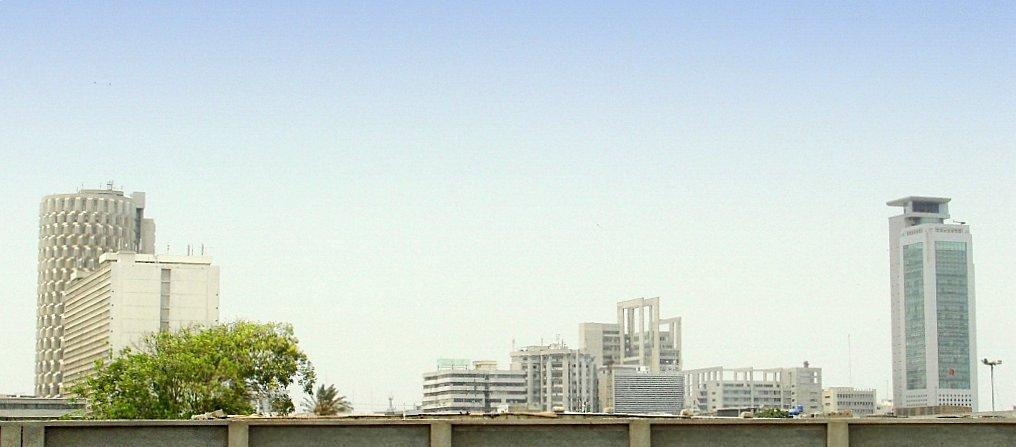
Photo: Swerveut / Wikimedia Commons ↗, Public domain ↗. Karachi’s financial district, photographed in 2004.
The SBP Payment Systems Review FY26, announced by the State Bank of Pakistan on October 6, 2026, puts digital channels at 92% of retail payment transaction volume, compared with 88% in FY25. The figure describes transactions in the review’s retail payment system coverage. It does not mean 92% of people use digital payments or that cash accounts for only 8% of purchases across Pakistan.
SBP’s official release ↗ reports 14.3 billion transactions worth Rs673 trillion through the formal banking system during FY26. Transaction volume increased 58% and value increased 10% over the previous year.
The figures SBP reported
| Measure | FY26 result | Comparison stated by SBP |
|---|---|---|
| Formal banking system transactions | 14.3 billion | Volume up 58% |
| Value of those transactions | Rs673 trillion | Value up 10% |
| Digital channel transactions | 13.2 billion | Volume up 65% |
| Digital share of retail payment volume | 92% | 88% in FY25 |
| Mobile application transactions | 11.1 billion | Volume up 79% |
| Internet banking transactions | 0.3 billion | Volume up 15% |
Source: SBP release dated October 6, 2026 ↗, checked October 8, 2026.
The four-percentage-point increase from 88% to 92% is a change in the share of retail transaction volume. It should not be presented as a four-percent growth rate, nor as the share of total payment value.
Mobile applications account for the largest digital transaction count in the release. The 11.1 billion figure counts transactions, so repeated payments by the same customer each contribute to it.
More terminals and app registrations
SBP also reports 337,791 point-of-sale terminals serving 295,367 merchant locations. It says daily card-based transactions averaged 1.5 million, compared with 1.0 million the previous year.
The release lists 99.1 million registered branchless banking mobile-app users and 30.4 million registered bank mobile-app users. These are separate registration measures. Adding them together would not establish the number of unique people using financial apps.
Those measures describe access and recorded activity. They do not establish that every registered customer is active, every merchant location accepts every payment method, or every payment attempt succeeds.
What this means for you
The review provides a national picture of payment activity; it does not announce a new fee schedule or raise your individual account’s transfer allowance. For a particular transaction, check the route and the rules published by the bank or wallet.
Our IBFT and Raast comparison explains the separate transfer routes. The Raast reference keeps the relevant official rules and bank-specific information together. Wallet users can also check the documented service routes for Easypaisa and JazzCash.
The release refers to PRISM+, introduced in August 2025 with ISO 20022 messaging. That is background to the annual review, rather than a new launch on October 6.
Sources
- State Bank of Pakistan: Annual Payment Systems Review FY26 release ↗, October 6, 2026; read and checked October 8, 2026.
- Wikimedia Commons: Karachi Chundrigar skyline photograph ↗, photograph by Swerveut, public domain. The image is contextual, not a photograph of the review’s publication.