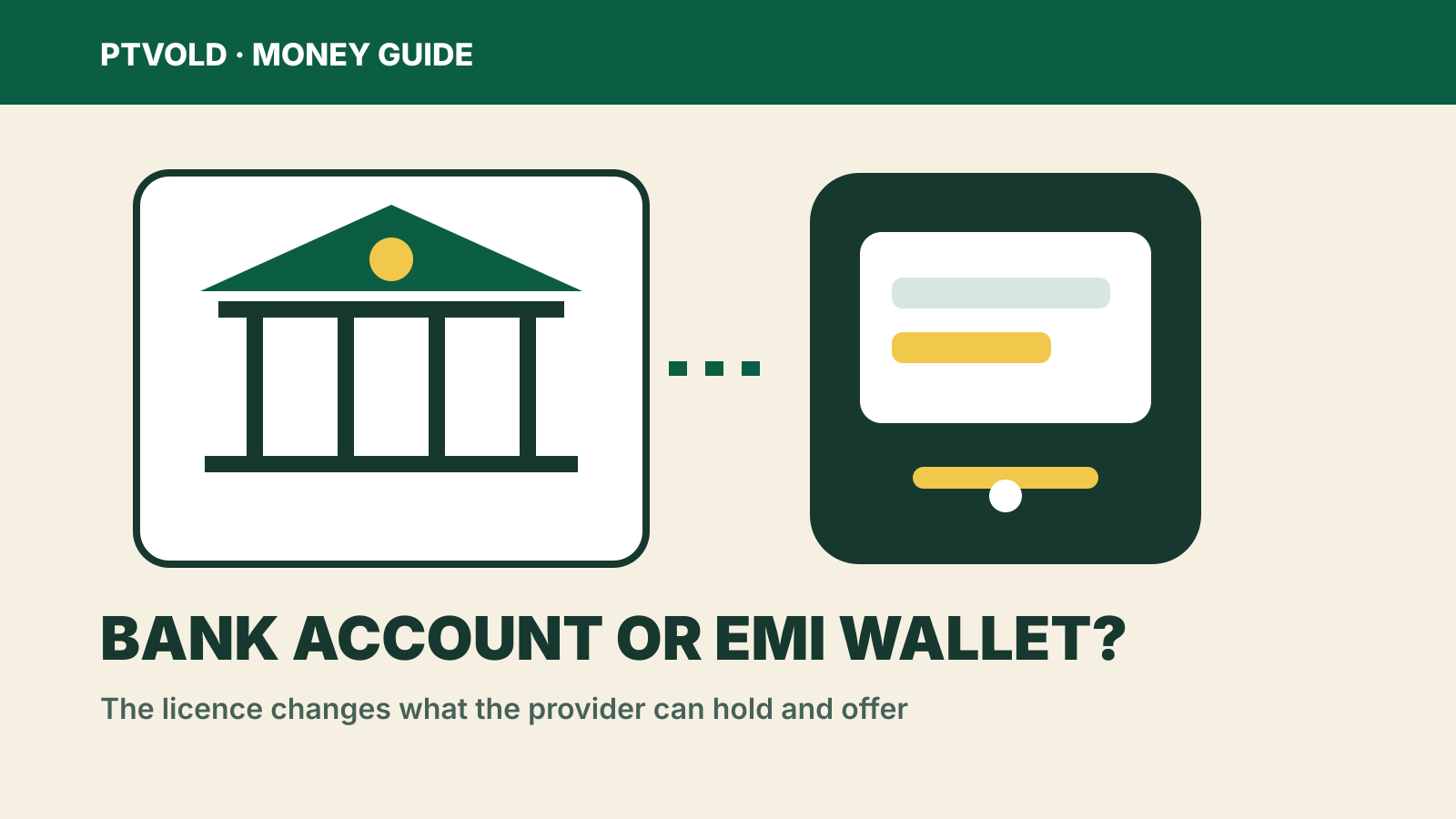
A banking app and a wallet app can both show a balance, accept transfers and let you pay. In Pakistan, that does not mean they operate under the same licence.
A bank account is provided by a bank or microfinance bank supervised by the State Bank of Pakistan. An electronic money wallet is provided by an Electronic Money Institution, or EMI, under separate payment-system regulations. The difference matters when you ask what the balance represents, what services the provider may offer and where to check its status.
Sources checked: 29 October 2026. SBP revised its EMI regulations in 2023 and published a consolidated licensing handbook on 28 October 2026.
What an EMI is allowed to provide
SBP describes EMIs as non-bank entities that provide low-value, interoperable digital payment instruments. Its examples include wallets, prepaid cards and contactless payment instruments.
That is a payment role. An EMI can receive money into an e-money wallet, let the customer use that value for supported payments and transfers, and issue instruments permitted by its approval. It does not become a bank because the app has an account-like screen.
SBP grants an EMI approval in stages: in-principle approval, permission for pilot operations and final approval. A provider still in a pilot stage should not be described as fully licensed for unrestricted commercial operations.
What a bank account adds
A bank is licensed under Pakistan’s banking framework to carry on banking business. In practical consumer terms, a bank account may sit alongside services that an EMI licence alone does not authorise, such as deposit products, financing and a wider set of banking facilities.
A digital bank is still a bank. “Digital” describes the delivery model; it does not turn the institution into an EMI. SBP’s 28 October 2026 licensing circular lists banks, digital banks, microfinance banks and EMIs as separate regulated-entity types covered by the new handbook.
This is why a wallet brand and a digital bank can look similar in an app store while having different legal permissions.
Does an EMI hold deposits?
Treat the word “deposit” carefully. An EMI wallet stores electronic value for payments. It is not automatically a bank deposit account, and the provider should not market itself as a bank unless it holds the relevant banking licence.
For a customer, the useful question is not whether the screen says “balance.” Ask which regulated entity issued the wallet or account and under which approval. A bank may also operate or partner with wallet services, so the consumer-facing brand alone may not answer that question.
How to check a provider
Start with the provider’s legal name, not only the app name. Then check the relevant SBP list and approval stage.
Look for:
- whether the provider is a bank, microfinance bank, digital bank or EMI;
- whether an EMI has in-principle, pilot or final approval;
- which legal entity appears in the terms and privacy notice;
- whether the product is a wallet, prepaid instrument or bank account;
- which complaint channel and regulator the provider names.
A download page, social-media badge or the word “licensed” without a licence type is not enough proof.
Which one should you use?
The choice depends on the job. An EMI wallet may be convenient for day-to-day payments, transfers and a prepaid balance. A bank account may be the appropriate home for deposit products and services that require a banking relationship.
Compare products within their actual permissions. A wallet is not inferior because it is not a bank account, and a banking licence does not make every bank app equally suitable. Fees, limits, cash-in routes, transfer support and complaint handling still need checking for the specific product.
If you are opening an account remotely, ptvold’s guide to digital bank account verification explains the identity and due-diligence checks banks may perform.