
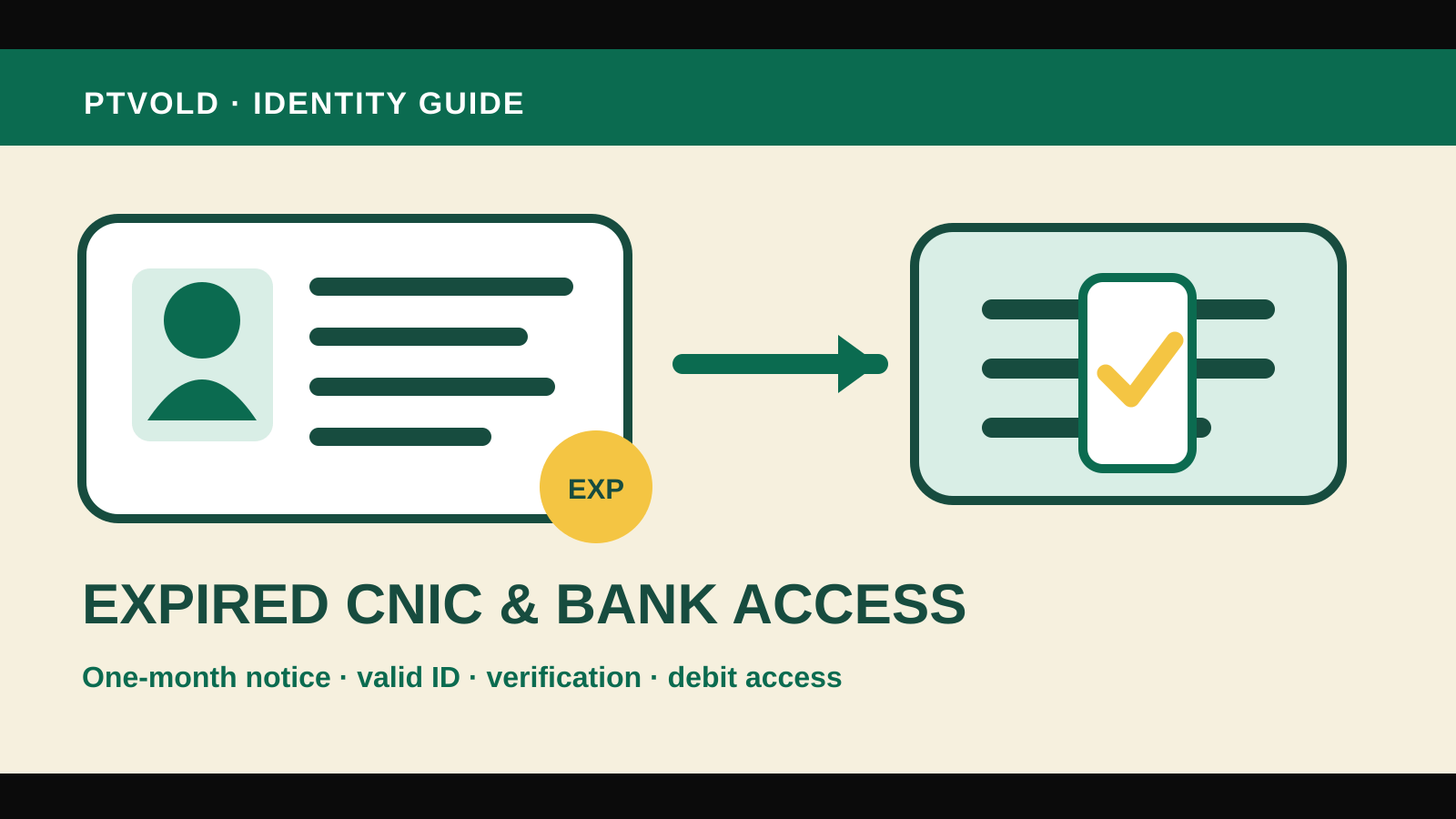
An expired CNIC can affect bank account access in Pakistan because banks and other entities regulated by the State Bank of Pakistan must keep a valid identity document on record. After giving one month’s prior notice, the institution must block debit transactions and withdrawals until a valid document is submitted and verified.
Checked 1 November 2026. This guide follows the State Bank of Pakistan’s AML/CFT/CPF Regulations for Regulated Entities. It covers the regulatory baseline; your bank may use its own secure channel and customer-verification process.
What the SBP rule requires
The current SBP regulations define the valid identity documents that can apply to a natural person, including CNIC, SNIC, NICOP and SNICOP for Pakistani citizens, as well as the relevant valid document for a foreign citizen, person of Pakistani origin, registered alien or Afghan refugee.
A regulated entity must block an account without a valid identity document for all debit transactions and withdrawals, regardless of the payment method. It must serve one month’s prior notice first. The debit block must be removed after the customer submits a valid identity document and the institution verifies it.
That means the restriction can reach:
- cash withdrawals at a branch or ATM;
- card purchases;
- cheques;
- outgoing bank transfers;
- payments initiated through mobile or internet banking; and
- standing instructions that debit the account.
The regulation describes a debit block, not automatic account closure. It does not say that the balance is forfeited. A bank may still have to review other restrictions, customer-due-diligence information or product conditions before restoring every channel.
What should happen before CNIC expiry
For a CNIC that expires during an existing customer relationship, the SBP framework requires regulated entities to maintain systems that can generate an alert at least one month before the expiry date. They must continue taking reasonable measures to obtain renewed identity evidence after expiry.
The institution may use a NADRA Verisys report of the renewed CNIC and retain it as the identity record. It may also obtain a copy of the renewed CNIC where necessary. This is why one bank may ask you to upload or show the new card while another can verify the renewal through NADRA data.
Keep the bank’s registered mobile number, email and address current. A notice sent to an old number can still leave you without time to update the record. If your identity document is approaching expiry, ask the bank which channel it uses for renewal evidence before access is restricted.
How to restore debit access after an expired CNIC
Use a bank-controlled channel and keep a record of each step.
- Renew the identity document. Follow NADRA’s official process and keep the application or token evidence.
- Contact the bank through an official channel. Use the app, internet-banking portal, number printed on the bank’s website or a branch.
- Confirm the reason for the restriction. Ask whether the account is blocked because the identity document is invalid, because customer information needs an update, or for another reason.
- Submit the valid document through the bank’s approved method. This may be a branch review, secure upload, biometric verification or a NADRA-backed verification process.
- Complete any linked customer update. The bank may need current contact, occupation, source-of-income or tax information as part of ongoing customer due diligence.
- Ask for a request or complaint number. A reference makes it easier to follow up if the debit block remains.
- Wait for verification, then test access carefully. Check the account status and recent transactions before making an urgent or high-value payment.
- Confirm each channel. Card, ATM, cheque, mobile and internet-banking access can have separate controls.
Do not send a CNIC image, biometric data, password, PIN or one-time code to a person who contacts you through an unverified number or social account. Start from the bank’s official website or app.
Is a NADRA receipt enough?
The regulations distinguish between opening a relationship and maintaining an existing one.
For a new account, the current annex to the SBP regulations allows the process to begin using attested copies of the NADRA receipt or token and the expired CNIC, provided the regulated entity obtains the renewed CNIC within three months. The bank still has to complete its other account-opening and verification requirements.
For an existing account under a debit block, the core rule says the block is removed after a valid identity document is submitted and verified. A receipt can show that renewal is in progress, but it should not be assumed to restore debit access by itself. Ask the bank whether it can verify the renewed document through NADRA and what additional evidence it requires.
What if the bank can see the renewed CNIC through NADRA?
The SBP framework permits regulated entities to use NADRA Verisys reports of renewed CNICs and retain them as evidence. That permission does not mean the update is automatic at every bank.
Give the bank the renewal details and ask it to run the approved verification. If it still requests a card copy or in-person step, ask whether that requirement is part of identity verification, a risk review or a product-specific process. Do not assume the bank’s database updates immediately when NADRA issues a document.
Joint and business accounts
For a joint account, the regulations require a valid identity document for each joint holder and customer-due-diligence measures as though each holder were an individual customer. The effect of one holder’s expired document can depend on the operating mandate and the bank’s controls. Ask whether the restriction applies to the whole account or only to instructions involving that holder.
For a sole proprietorship, partnership or company, the bank may also need valid documents for proprietors, partners, directors, beneficial owners or authorised signatories. Replacing one signatory’s CNIC may not complete a wider customer-information review.
Do not use a personal account as a substitute for a business account merely because a business signatory’s record is delayed. The SBP regulations restrict personal accounts used for business, subject to limited treatment for proprietorships, small businesses and professions when the institution is satisfied with the KYC profile, purpose and expected turnover.
Expired CNIC, dormant status and account closure
An identity-document block and dormancy are separate controls. An active account can lose debit access because its identity document is invalid. A dormant account can also require an authenticated activation request. Ask the bank to state which restriction applies, because the steps are different.
Closure is different again. If you no longer need the account, use the bank-account closure checklist and obtain written confirmation of the final balance and closure.
If the bank says the account is dormant rather than identity-blocked, request the specific activation procedure and do not assume that uploading a CNIC alone will reactivate it.
If the bank does not remove the block
Give the bank a concise written record:
- account number or IBAN, partially masked in ordinary correspondence;
- renewed identity-document type and expiry date;
- date and channel of submission;
- verification or biometric step completed;
- request reference;
- date debit access was expected; and
- the exact action requested.
Avoid attaching a full identity image to an ordinary email unless the bank’s verified instructions require that channel.
If the institution does not resolve the issue, use its formal complaint process. The Sunwai complaint guide explains how to lodge and track a complaint and when an escalation route may apply.