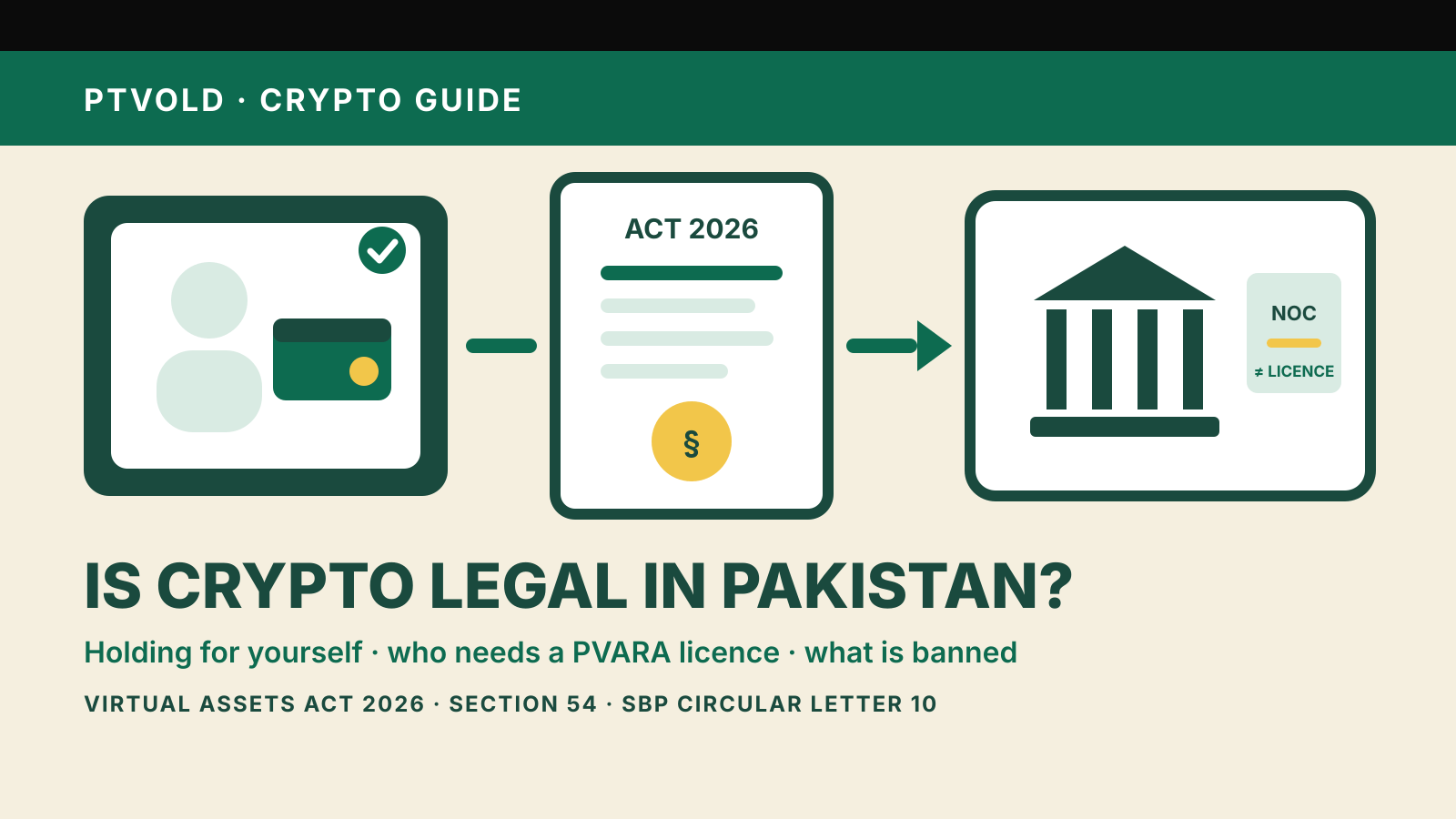
Yes. Since March 5, 2026, crypto in Pakistan has been regulated, not banned. The Virtual Assets Act, 2026 licenses the businesses that sell, hold or exchange crypto for other people. It does not make it an offence for you to own crypto or to buy and sell it for yourself. What is illegal is running a crypto service for others without a PVARA licence, and that carries up to five years in prison.
Short answer Owning crypto and trading it for your own account is legal in Pakistan. The law’s licensing rules apply to businesses that provide crypto services to other people. As of November 15, 2026, PVARA has granted no full licence: Binance and HTX hold NOCs (a first step, not a licence), and firms that applied before September 5, 2026 may keep serving existing users while PVARA decides. Crypto is not legal tender, so no shop or person has to accept it.
By ptvold Desk. The Act, both sets of PVARA regulations, PVARA’s FAQ, licensing and news pages and SBP’s circular letter were read on November 15, 2026. This is a reading of the law, not legal advice.
Risk Crypto-assets are highly volatile and you can lose all the money you put in. Use only platforms with PVARA approval. This is not a recommendation to buy.
What the law covers, and what it leaves to you
The Act applies to two groups: virtual asset service providers that work “in or from Pakistan”, and issuers that offer a token in or from Pakistan (section 2). A service provider is defined as “any person who, as a business, provides one or more Virtual Asset Services to third parties on a professional basis” (section 3). The ten kinds of service are listed in the Act’s Schedule I. Buying a coin for yourself is not one of them (Virtual Assets Act, 2026 ↗, checked November 15, 2026).
Two exemptions in Schedule I settle the most common worries. Someone who “deals solely on its own account, does not execute orders on behalf of customers, and does not hold or control Customer Assets” is not a broker-dealer. And “pure mining for own account is excluded” from the mining category.
| What you do | Needs a PVARA licence? | Where the law says so |
|---|---|---|
| Buy, hold or sell crypto for yourself | No | Section 3 (provider = business serving third parties); Schedule I broker-dealer exemption |
| Keep coins in your own wallet | No | Not a service to others; custody means holding assets “on behalf of customers” (Schedule I) |
| Mine for yourself | No | Schedule I: “pure mining for own account is excluded” |
| Buy and sell for other people, or hold their coins, as a business | Yes | Sections 3, 18 and 19; Regulations 3(1) and 5(1) |
| Run an exchange, app or website that serves users in Pakistan | Yes, wherever the company is based | Section 2; PVARA FAQ question 6 |
| Launch your own token or coin offering | Only under the Act’s rules | Section 51 |
Source: Virtual Assets Act, 2026 ↗ and PVARA FAQ ↗ · checked 2026-11-15
The Act does not say how many trades turn personal trading into a business. If you regularly buy coins to sell to other people for a margin, for example on a peer-to-peer market, you are closer to the “as a business … to third parties” line than someone who buys and holds. PVARA’s FAQ puts the test as engaging in a service “by way of business” (question 5).
What is an offence, for anyone
Section 54 of the Act sets the penalties. Each of these can apply to an individual, not only to a company:
| Offence | Section | Maximum penalty |
|---|---|---|
| Willfully providing an unlicensed virtual asset service | 54(1) | 5 years’ imprisonment, a fine of up to Rs50 million, or both |
| Market manipulation, or trading on inside information | 52, 54(3) | For a person: 3 years, up to Rs25 million, or both |
| An initial coin or token offering outside the Act | 51, 54(2) | 3 years, up to Rs25 million, or both |
| A false statement in an application to PVARA | 54(4) | 3 years, up to Rs20 million, or both |
Source: Virtual Assets Act, 2026, sections 51 to 54 ↗ · checked 2026-11-15
Section 53 also bars issuing or marketing an algorithmic token that is not fully collateralised, unless regulations allow it. The definition in section 3 adds: “Virtual Assets are not legal tender.”
Where you can trade today
Only a licensee may serve users once the transition is over, and PVARA has announced no licence yet. The public register of licensees that PVARA must keep (regulation 9(6) of the Services Regulations) is where the first names will appear. PVARA’s licensing page still describes the requirements “when full licensing becomes available” (PVARA licensing ↗, checked November 15, 2026). That leaves two groups:
- NOC holders. PVARA’s news page names Binance and HTX, both from December 12, 2025 (PVARA news ↗, checked November 15, 2026). A NOC lets a firm incorporate in Pakistan and work towards a licence. It is not a licence.
- Transitional applicants. Section 70 gave firms already serving Pakistani users until September 5, 2026 to apply or stop. A firm that filed a complete application may keep offering its existing services, provided it follows PVARA’s interim directives (PVARA home page ↗, checked November 15, 2026). PVARA has not published a list of these applicants.
A platform based abroad still counts as working “in or from Pakistan” if it targets, promotes to or onboards people in Pakistan, offers payment in rupees, or runs channels open to people here (PVARA FAQ, question 6). Our PVARA licence tracker lists each platform’s status with its source.
Once licences are issued, the Services Regulations ↗ give users some concrete rights. A licensee must acknowledge a complaint within 24 hours and send a written update if it is not resolved within seven working days (regulation 53). It must publish its licence number and licence categories on its website (regulation 54).
Two activity rules from the Activity Specific Regulations ↗ will shape what licensed apps can offer:
- an exchange may not offer margin, futures, perpetuals or other leveraged products unless its licence expressly permits them (Exchange regulation 19);
- a transfer provider may not move client coins to or from self-hosted or unverified wallets except under controls PVARA sets (Transfer and Settlement regulation 12).
Your bank account and crypto
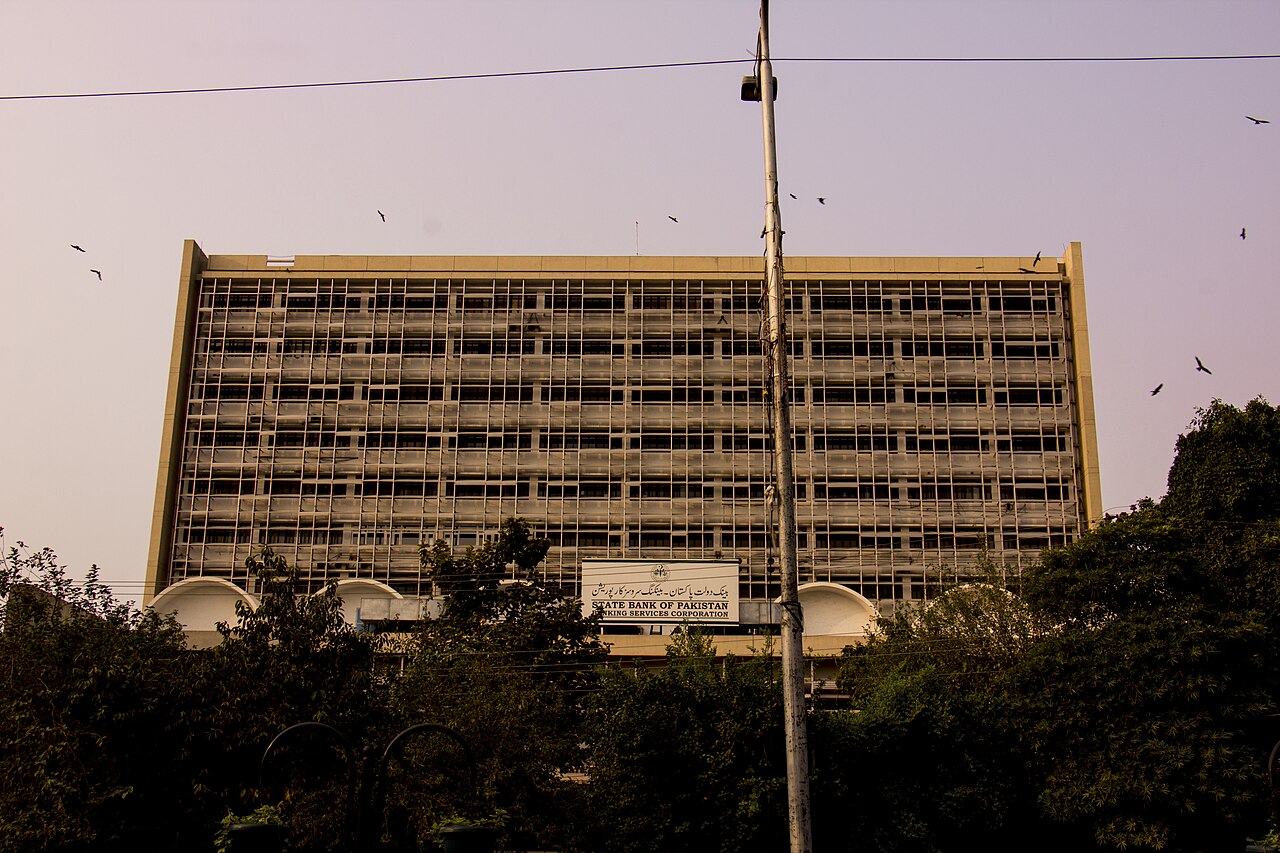
The State Bank lifted its 2018 ban on banks dealing with crypto firms through BPRD Circular Letter No. 10 of 2026, dated April 14, 2026, which replaced BPRD Circular No. 03 of 2018. Under it, banks may open only limited-purpose accounts for NOC holders. Virtual-asset transactions through banks come only after PVARA grants a licence. Settlement for licensed firms runs through rupee “client money accounts” that take no cash deposits or withdrawals, and banks themselves may not invest in, trade or hold crypto (SBP BPRD Circular Letter No. 10 of 2026 ↗, checked November 15, 2026).
Under the circular, until PVARA licenses a platform, a bank may not offer it virtual-asset transaction services. The Services Regulations also state that they do not override the Foreign Exchange Regulation Act, 1947 or the Anti-Money Laundering Act, 2010 (regulation 2(2)), so sending rupees abroad to buy crypto stays under the existing foreign exchange rules.
Warning A seller, agent or social media page may claim to be “PVARA licensed”. PVARA has not yet issued a full licence, and the only NOC holders it names are Binance and HTX. Ask for a licence number and check it against PVARA’s register and pvara.gov.pk before you send money.